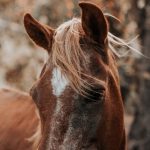
That quick, the little mustang lost his way in this new thing we were doing together, and he went to bucking with a show of exuberance native only to those in the hot blush of youth.
His heels went high and his head went low and he put that move on repeat for quite a few cycles before I began to entertain some doubts regarding the sustainability of my position, bouncing around up there on top of his back.
Sure enough, about the time we’d completed one full lap of the round pen bronc-style, I got a little off-kilter in the saddle, tilted a smidge to the outside, came totally loose sideways, and got briefly but bracingly squashed between the colt’s jouncing ribs and the sturdy steel rails of the fence.
My ride sped away and I plopped to the ground.
Now that the pressure was off, I took a moment to reconsider the wisdom of the project I’d signed on to a year before, when I brought home a wild, skinny, scared yearling colt, all tangles and tribulation.
I lay there bruised and panting under the bland October sun and, not for the first time, I wondered whether I was truly capable of keeping up my end of the deal, me being not so very young myself.
***
A few days later, a friend asked me if the wreck had changed the way I feel about the colt.
The question caught me off guard.
Since the day I was born, nothing has changed the way I feel about any horse, anytime, anywhere, ever.
No, I answered. But I worry it might change the way he feels about me.
I worry because the way my horses feel about me matters more than anything else to my safety, my comfort, and my joy in communing daily with these remarkable beings.
If a horse understands you, trusts you, respects you—believes in you—he’ll put his life in your hands, and you can get just about anything done together.
Not only that: there will be beauty in it, and art, and grace of a sort rarely seen among humans reckoning with their own kind.
Trouble is, becoming someone a horse can believe in might take a person a lifetime and then some, especially if the person got kind of a late start on it.
I was well into middle age when I discovered a way of being with horses that felt right to me.
At first, I thought it was all about techniques and principles and mechanics: how the horse thinks, how he learns, how he moves, what he needs, what he fears; how to handle a rope or a rein, how to guide his feet, where to put your weight, how to hold your ground, and so on and on and on and on.
It was complicated and confusing, but really fun, too.
With time, the thing got simpler and much, much harder.
It became less about what I know or what I do, and more about who I am.
I’ve had to change quite a bit to get along better with my horses, and the remodel is still very much in progress.
I read somewhere that good horsemanship takes feel, timing, balance—and something else.
I thought I was getting the hang of it, I really did.
Then along came the new colt.
***
Lying flat on my back in a big pile of ouch, I do a quick triage of my extremities.
No broken bones or gushing wounds: that’s all I need to know for the moment.
I pull myself upright hand over fist with the help of the fence rails.
When the colt sees me standing, he makes a beeline for me across the pen, legs flailing, feet stumbling, stirrups flapping loose at his sides.
He’s panting even harder than I am.
Where’ve you been?? he demands to know. You would not believe the crazy thing that just happened to me!!
Poor little guy, what a fright he’s had!
I take the lead rope and guide his feet in some gentle lateral steps that will calm both our jitters, his and mine.
Then we stop and I stroke his neck while he nuzzles close for comfort.
He doesn’t seem to realize I am the very fool who set him up for all that uncommon consternation in the first place.
So I got lucky this time: I’m still the colt’s hero.
And he sure is mine.
And we’re still in this thing together, he and I, like we have been from day one, like I hope we always will be.
 The New Colt