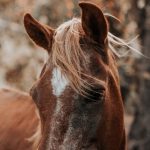
The colt won’t come out of the trailer.
He’s got all four toes bunched up at the edge of the floorboards and his head craning out the open doors just as far as it’ll go without tipping him tail-over-teakettle onto the grass a few inches down.
The balancing act is especially impressive given that he’s hollering nonstop at top volume.
It’s a whole-body thing: the air bursts from his lungs, his windpipe ripples, his rib cage rattles, and his legs shake hard enough to rock the frame of my old Circle J.
Each cri de coeur ends with a sharp, hollow snort. Then he gulps some breath and launches into the next one.
So now the entire valley knows we’re home.
I guess I was kind of hoping to sneak the little mustang in: nuthin to see here folks, just the crazy pony lady adding another mouth to her motley crew of grass-munchers.
My sleepy little delta is mostly farmland, but of the dense, highly developed type–which is to say, I have a lot of neighbors close in.
I bet they’re all grilling steaks and swilling beers on their decks at this very moment, hoping to enjoy one quiet hour of precious R&R in the middle of the work week.
Instead the warm and erstwhile peaceful summer evening erupts in a regular Woodstock of animal song.
The equines in the home herd start yelling back to the colt in equally shrill tones.
The neighborhood dogs howl and leap at their gates. The chickens next door are flapping and squawking. Goats are bleating, donkeys are braying, guinea fowl are clacking, there’s sounds I don’t know what the heck they are.
And just when I think it can’t possibly get any louder, from far across the back field come the outraged cries of the peacocks.
Peacocks sound like decommissioned pterodactyls.
When they join in, even the panicked colt stops hollering for a second to listen.
He’s thinking heck, now I’m definitely not setting foot outside of this trailer.
I could toss a rope at his rump to shoo him out, but truth be told I need a break in the action.
I have just single-handedly heaved around four 12-foot, 90-pound, six-rail metal fence panels to build a chute between the back of the trailer and the round pen.
On the long drive back to the farm, I’d mentally rehearsed how to open the round-pen panels against the sides of the Circle J so the colt couldn’t squeeze out into the larger world beyond the pen.
But like most of my carefully planned projects, this one hit a few snags in the execution.
First there was the challenge of backing the trailer through the gate at just the right angle to the pen.
The phrase “backing the trailer” alone will usually suffice to drain the blood from my face, with or without complicating angles and gates.
Next I discovered that some of the pins that hold the panels together were stuck tight in their sockets.
I pounded them loose with my bare fists, switching back and forth between left and right so as to minimize the damage to any one hand.
The panels still wouldn’t budge, owing to the fact that a few inches of sod had grown over the U-shaped feet at the bottom.
I dug those out by repeatedly kicking at the sod with the blunt toes of my work boots, switching from left to right etc.
Yes, I have a hammer and yes, I have a shovel, but neither of those tools was at hand just then, and I was in a hurry.
The colt was bouncing around in the trailer all the while, yelling, and I hoped to get him out before he hurt himself.
In an ideal scenario, of course, I would have done all this pounding and digging and heaving before I brought the colt home.
But the circumstances under which I came into possession of this baby horse were far from ideal.
It all transpired a bit faster than expected.
It was kind of an emergency situation.
And now my new colt–my first young, wild, unhandled horse–stands on the precipice of his new life, unable or unwilling to take that first step into the great unknown.
Given the enormity of his agitation, I’d thought he would bolt out of the trailer just as soon as he saw daylight between the doors.
But when I review the day’s events from his perspective, I can see why he’d want to stay put.
 The New Colt