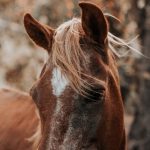
The colt came to me from hard circumstances.
He was born into a cramped, muddy pen in the woods of a rural backyard where a small band of feral mares and stallions had been left to breed and starve.
The pen wasn’t much bigger than the combined volume of the horses contained within it.
There was no space to run or roll, hardly any room to lie down, and no shelter, either.
No way to escape the wind and rain and biting bugs.
No care for wounds or worms.
No one to brush out matted hair or trim sore, overgrown feet.
The colt’s family lived like this for years before he was born.
Manure and urine mixed with the mud and turned the tiny enclosure into a stinking swamp.
Hay came sometimes, but never enough.
The hungry horses tried to push through the fence to the grass just out of reach.
They ate the bark off of tree trunks and dug up the roots.
The fence held. The trees died.
And each spring the herd grew by a head or two, so things got worse.
Some of the babies perished in the deep muck, unable to stand up to nurse.
My little colt survived. Eighteen months, give or take: a long yearling.
Then one day in early summer some new people showed up with hay–piles and piles of it.
The stallions and boss mares chased the colt from the piles at first, as they always did on those rare occasions when food arrived.
But this time, when he finally got near, there was still plenty of hay left in the piles.
This time, the colt got to eat until his belly was full.
The new people brought more hay again the next day, and then the next day, and the day after that, and then again.
Day after day there was something to eat, and fresh water in the trough, too, with no leaves or bugs or dirt mixed in, nothing growing in it.
The taste of the clean, cold water was startling, almost sweet.
He got used to it fast.
Sometimes the new people came into the pen and stood among his family, which was very scary at first.
But then his father, the herd’s bold and noble patriarch, ventured close enough to catch a whiff of something that smelled very good.
The stallion trembled as one person lifted her arm and opened her fist, speaking softly, breathing calmly, waiting.
The colt watched how his father sized up this offer: his body taught, poised to defend, and then, when no threat materialized, slowly lowering his head, stretching out his neck, and snatching the nugget with his lips.
Before long several other grown-ups had gotten close enough to the people to eat from their hands, too.
The colt kept watching from a safe distance.
He was still afraid, but another feeling crept in, too: curiosity.
It made him restless like fear, made him tingle like fear, but it was not fear.
And soon it grew stronger than fear.
One sunny morning after he’d eaten his fill of hay, the colt gathered up his courage, inched toward the people, stretched out his neck, and took a nugget with his own lips.
He worked his jaw to move the nugget to the big teeth in back, then crunched down hard.
It was delicious. Another new sensation!
The treat was a turning point for the little mustang.
He became a very brave colt who greeted the new people every day, even while some of the more timid horses still shied away.
He learned he could walk right up to the people to get his treat, and if he stayed, he’d get more.
Once, while he was munching, he even let a person touch him on the shoulder.
It was just a single, light stroke, but it felt good.
He allowed some gentle rubs on his neck, then his shoulders and back.
He stood close and welcomed the contact.
By the end of the week the whole herd had accepted the new people into their midst and settled into a comfortable routine.
Now there was something more than daybreak and nightfall to fill their hours.
Now they could lift their heads from the motionless huddle they’d stood in to conserve strength and warmth.
Now their ears came forward, their steps quickened, their eyes brightened.
It was all very exciting for the colt.
There was so much to watch, so much to feel, so much to think about, so much to eat.
The colt began to come alive to his own experience of living.
Which is why what happens next will always seem a cruel interlude to me, no matter how necessary I know it to be.
 The New Colt