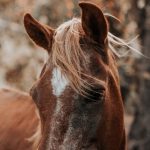
I finally got the baby horse I’d set my heart on, and the rest of his herd would soon find safe homes, too—a cause for celebration if ever there was one.
But that night, after I’d unhitched the trailer and parked the truck, picked the paddocks and fed the home herd, closed up the barn, knocked off my boots, and gone inside for dinner, I found myself brooding at the kitchen table, my sandwich left untouched on the plate.
The things I’d seen over the last two days began to settle their terrible weight upon me.
The mud, the filth, the hopeless eyes, the misshapen hooves, the hollows around the hip bones, the bellies swollen with parasites: all these images made for a woeful pondering.
Even the contours of the colt’s little paddock bespoke years of desperation.
There was the trench along the fence line where the horses had tried to nose their way to the grassy lawn just beyond reach.
There were the sullen grey trunks of the dead firs and cedars, killed long ago when the horses had stripped the bark and dug up the roots just to have something, anything, to chew on.
The mares with foals had it worst of all, each wasted body supporting not one life but two.
I pictured the colt’s mother, a shy, tiny thing, her growth stunted by malnourishment, her neck a narrow band of sinew hung with the long, knotted ropes of her mane.
Was she still crying out for her baby at this very moment while, miles and miles away, her baby called for her?
Because sure enough, from my place at the kitchen table, I could hear the colt hollering outside in the near dark just as loud and shrill and frantic as ever.
No doubt he was still circling the pen, too, completely ignoring the grass and the water and the big pile of hay I’d left for him.
A starving horse too scared to eat—yet another woeful pondering.
Well, thought I, this is a sorry state of affairs, albeit a familiar one.
Once again I have fallen into the empathy well.
The empathy well is a dark abyss in which I struggle to separate my own emotions from the feelings of those I care about.
Especially the fear and pain of animals.
When I picture their suffering, the ground drops out from under me and down I plummet, into a black and bottomless pit that swallows up all sense of perspective.
***
Now I’m aware that, generally speaking, empathy is a good thing.
It binds us in compassion to one another and other living things, reminds us of our common project here on this earth.
People are hard-wired for it, too.
Some years back, scientists discovered so-called mirror neurons in the brain that fire when we watch the behavior of others, making us feel just as though we were performing those actions ourselves.
I suppose the effect amounts to a kind of wireless coupling between brains, breaching the boundary between self and other.
I imagine that’s how horses experience their lives in a herd: collectively, with permeable borders, thought and feeling and motion a great diffuse contagion.
Maybe that’s how they move together as one body, racing like a thunderhead’s shadow across an open valley, turning in unison at a fence or a cliff face, pouring through a gate or a track in the woods as though governed by a single, animating idea.
Whenever I’m riding or even just hanging out with my horses, I’m always searching for that synchrony, a dance of mutual responsiveness equines instinctively share.
Empathy helps me find it.
But my sensitivity to the suffering of animals has some drawbacks, too.
Teaching a horse to load in a trailer, for example, is a real struggle for me.
I catch the prairie prey animal’s fear of being cornered in a tight, enclosed container, and that fear seems entirely reasonable and right to me.
By my own nature, I am not a claustrophobic person.
I’ve lived happily for years in studio apartments not much bigger than one of my box stalls.
I’m at ease riding in elevators and lying in MRI scanners.
In my 20s I went caving on weekends, crawling between subterranean slabs of bedrock just for fun.
But time and again, when I teach a horse to load in a trailer, I have to work hard to remind myself that trailering is mostly safe and entirely necessary before I can stand in my horse’s presence as a credible ambassador of the notion.
And long ago, when I was a horse-crazy teenager, empathy kept me from choosing a career with horses: as a veterinarian, a farrier, a competitor, an instructor, a breeder, or a trainer.
In any of those professions, I knew, I’d encounter a lot of troubled animals I couldn’t help, if only because they belonged to people who didn’t care in quite the same way I did.
I was just a farm kid, with very limited exposure to the wider equestrian world, but I’d already seen more than enough disharmony between horses and humans to do me for a lifetime.
Most of the equine professionals I met were stressed and short-tempered.
Their horses didn’t seem all that happy, either.
The happiest equines I knew were pets kept for pleasure: the weekend trail horses, the beloved backyard ponies.
Not the show jumpers, not the schoolmasters, not the fancy warmbloods, not the thoroughbreds on the track.
Not the pros. Not the money-makers.
Then there was the problem of my own abilities.
Those few times I’d tried to prepare for a competition or “train” a horse, I wound up feeling confused and frustrated, and I daresay the horse did, too.
As long as I wasn’t trying to accomplish anything, as long as I wasn’t attempting any of the maneuvers I picked up willy-nilly from books and movies and TV shows, my equine friends and I got along great.
I was born loving horses, and after I finally got my very own pony at the age of 12, I spent all of my free time on her back.
We galloped through fields and forests, we jumped logs and poles and ditches, we splashed across streams, we rode in parades, we followed the hounds in the backwoods-bumpkin version of fox hunting the local farmers practiced drunk on Sunday mornings every autumn.
We even won the occasional ribbon at the local show.
But any attempt at “training” seemed to break the connection between my horse friends and me.
And connection was what I longed for most of all with horses.
So somewhere along the line, I decided I had no real knack for the horse thing.
I would have to find some other way to live out my life, some other way to earn a living.
I had not a thought in my head of what those other ways might be.
I left the farm and my pony to go to college, and I left horses in my past.
 The New Colt